
No products in the cart.
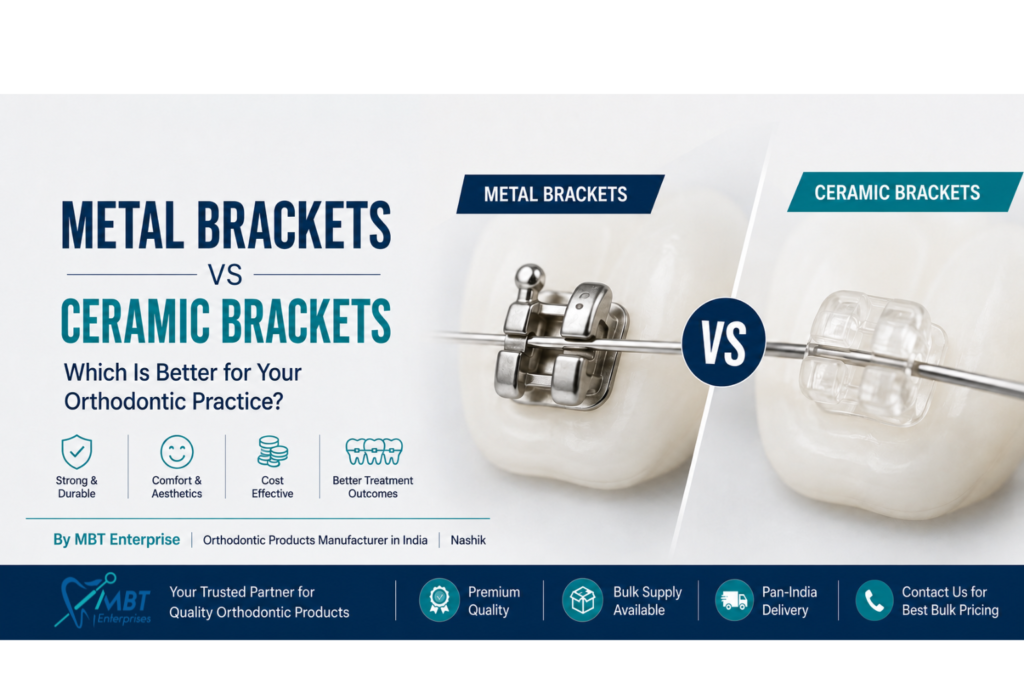
Choosing between metal and ceramic brackets is one of the most clinically significant decisions in orthodontic treatment planning. The bracket type affects not just aesthetics — it influences friction levels, wire compatibility, patient comfort, treatment duration, and long-term outcomes.
This article provides a straightforward, evidence-based comparison of both systems to help orthodontists make informed decisions for their patients. We cover material properties, clinical performance, accessory compatibility, and real-world considerations that matter inside the clinic.
What Are Metal Brackets?
Metal brackets are the traditional foundation of fixed orthodontic treatment. Made from high-grade stainless steel, they bond directly to the tooth surface and work in combination with archwires — typically NiTi wire in early stages and SS wire in later finishing stages — to apply controlled, graduated force and guide teeth into alignment.
They have been refined over decades and remain the most widely used bracket type globally, valued for their durability, low friction, and clinical predictability. Metal brackets are typically used alongside:
● NiTi wire — for initial light, flexible alignment
● SS wire — for later stages requiring rigidity and torque control
● CuNiTi wire — for thermally activated cases
● Bondable or weldable buccal tubes — to anchor the archwire at the molars
● O rings, elastics, and E chain — for ligation and space closure
What Are Ceramic Brackets?
Ceramic brackets are made from tooth-coloured polycrystalline alumina or zirconia. Mechanically, they work identically to metal brackets — but their translucent or tooth-matched appearance makes them far less visible, which is their primary clinical advantage.
They are commonly prescribed for adult patients and older teenagers where aesthetics are a priority, particularly in patient-facing professions or social contexts where visible metalwork is undesirable.
Head-to-Head Comparison
1. Aesthetics
Metal: Clearly visible. The silver profile stands out against enamel, especially under light or when smiling.
Ceramic: Blends naturally with tooth colour. Significantly more discreet and preferred by patients with high aesthetic awareness.
Clinical takeaway: Ceramic is the clear choice where patient confidence and appearance matter.
2. Strength & Durability
Metal: Highly resistant to fracture, even under heavy occlusal forces. Well-suited for younger patients, contact sport participants, and those with parafunctional habits like bruxism.
Ceramic: More brittle than metal. Susceptible to chipping or cracking under excessive bite pressure. Less suitable for high force cases.
Clinical takeaway: Metal is the more durable option, particularly for high-risk patients.
3. Friction & Wire Compatibility
Metal: Produces low friction with standard archwires, allowing smooth, efficient tooth movement. Works well across the full NiTi-to-SS wire progression.
Ceramic: Traditional ceramic generates higher friction. Modern ceramic brackets with metal slot inserts have narrowed this gap considerably and pair well with thermal NiTi arch wire and CuNiTi wire for consistent force delivery.
Clinical takeaway: Metal still holds a slight edge, but high-quality ceramic brackets with metal slots perform comparably.
4. Patient Comfort
Metal: Initial adjustment can cause mucosal irritation. Relief wax is a standard recommendation for the first few days post-bonding.
Ceramic: Smoother, more rounded bracket profiles reduce soft tissue friction and are generally better tolerated in the initial weeks of treatment.
Clinical takeaway: Ceramic brackets tend to be more comfortable, especially at the start of treatment.
5. Staining
Metal: Completely stain-resistant throughout the treatment period.
Ceramic: The bracket itself does not discolour, but elastic ligatures (O rings) used with ceramic brackets absorb pigment from food and beverages — particularly tea, coffee, and spiced foods — causing a yellowish tint between appointments.
Clinical takeaway: More frequent ligature changes are often needed with ceramic brackets to maintain appearance.
6. Cost
Metal: Lower cost per unit, making treatment more financially accessible for patients. Clinics sourcing SS wire in bulk alongside metal brackets can maintain efficient cost structures.
Ceramic: Higher manufacturing cost translates to higher treatment fees. Worth factoring into patient consultations.
Clinical takeaway: Metal is more economical; ceramic commands a premium that should be communicated to patients upfront.
7. Accessory Compatibility
Both systems are fully compatible with the standard range of orthodontic accessories. Essential
clinic inventory includes:
● Orthodontic bands — for molar anchorage
● Bondable buccal tubes — for direct molar bonding
● Weldable buccal tubes — for attachment to bands
● E chain — for space closure mechanics
● Orthodontic elastics — for inter-arch and intra-arch force application
● Dental etchant gel — for proper bonding surface preparation
● Relief wax — for patient comfort management post-bonding
8. Debonding
Metal: Safe and straightforward to remove at treatment completion with minimal enamel risk.
Ceramic: Requires careful technique. The combination of strong adhesion and material brittleness increases the risk of enamel fracture if debonding is not handled correctly.
Clinical takeaway: Metal offers simpler, lower-risk removal at the end of treatment.
Quick Comparison Table
| Feature | Metal Brackets | Ceramic Brackets |
|---|---|---|
| Aesthetics | Visible | Discreet, tooth-coloured |
| Durability | High | Moderate |
| Friction (NiTi / SS wire) | Low | Moderate (varies by type) |
| Patient Comfort | Moderate | Higher |
| Staining (O rings) | None | Ligatures may stain |
| Cost | Lower | Higher |
| Debonding Safety | Simple | Requires care |
| Best Suited For | Kids, high-force, budget cases | Adults, aesthetic priority cases |
Which Should You Recommend?
There is no universally superior bracket — the right choice depends on the patient in front of you.
● Metal brackets are best for children, teenagers, patients with strong bite forces,
bruxism, or those where cost is a primary concern.
● Ceramic brackets are best for adults and older teens where aesthetics are a priority
and the patient is committed to careful dietary and hygiene habits.
For most practices, stocking both bracket types and selecting based on individual case assessment leads to the best clinical and patient satisfaction outcomes.
Frequently Asked Questions
Q1: Can ceramic brackets be used with all archwires?
Yes. Ceramic brackets are compatible with NiTi wire, SS wire, CuNiTi wire, and thermal NiTi arch wire. However, clinicians should prefer ceramic brackets with metal slot inserts to minimise friction, especially during the active tooth movement phases.
Q2: Do ceramic brackets stain?
The ceramic bracket itself does not stain. However, the elastic O rings used to ligate the wire to the bracket can absorb pigment from food and beverages. Patients should be counselled on this, and ligature changes should be scheduled accordingly.
Q3: Are metal brackets suitable for adult patients?
Yes — metal brackets are clinically effective for any age group. Some adults prefer them for their durability and lower cost. However, patients with high aesthetic concerns typically opt for ceramic brackets or clear aligner alternatives.
Q4: How does bracket quality affect treatment outcomes?
Significantly. Inconsistent slot dimensions, poor torque values, or a weak bonding base can lead to unpredictable tooth movement, extended treatment time, and bracket failures. Sourcing from a quality manufacturer ensures clinical consistency across every case.
Q5: What is the role of buccal tubes in a bracket system?
Buccal tubes — either bondable buccal tubes (bonded directly to molar enamel) or weldable buccal tubes (welded to orthodontic bands) — serve as the terminal anchor point for the archwire at the molar. They are a critical part of the overall bracket system and must match the prescription and wire slot size of the selected bracket.
Q6: When should relief wax be recommended to patients?
Relief wax should be given to every patient immediately after bracket bonding, regardless of bracket type. It is especially useful in the first 5–7 days when soft tissue is adapting to the new hardware. Metal bracket edges, in particular, can cause mucosal irritation during this initial phase
